Pros of Professional Editing: how feedback makes a more mindful writer.
No matter how hard we studied literary rules in primary school, or aced our senior English essays, every writer has their own literary flaws.
It might be those parts of your personal style that seem right to you but might be jarring to a reader. Or it’s the literary rules you were convinced were right that might actually be wrong.
A punctuation mark you’re accidentally using incorrectly or in the wrong context?
Unintentional changes in tense throughout your book?
We’ve all been there. As the author we have our blinders on to some of these common errors or flaws. Or, as mentioned, we believe them to be correct until someone kindly lets us know that our sentences make no sense.
For me, that someone was my professional editor.
I know that for an author starting out, forking out a couple of thousand dollars for professional editing services is a huge investment. It can be an overwhelming and daunting consideration because it is a lot of money to spend on a manuscript that may not end up anywhere.
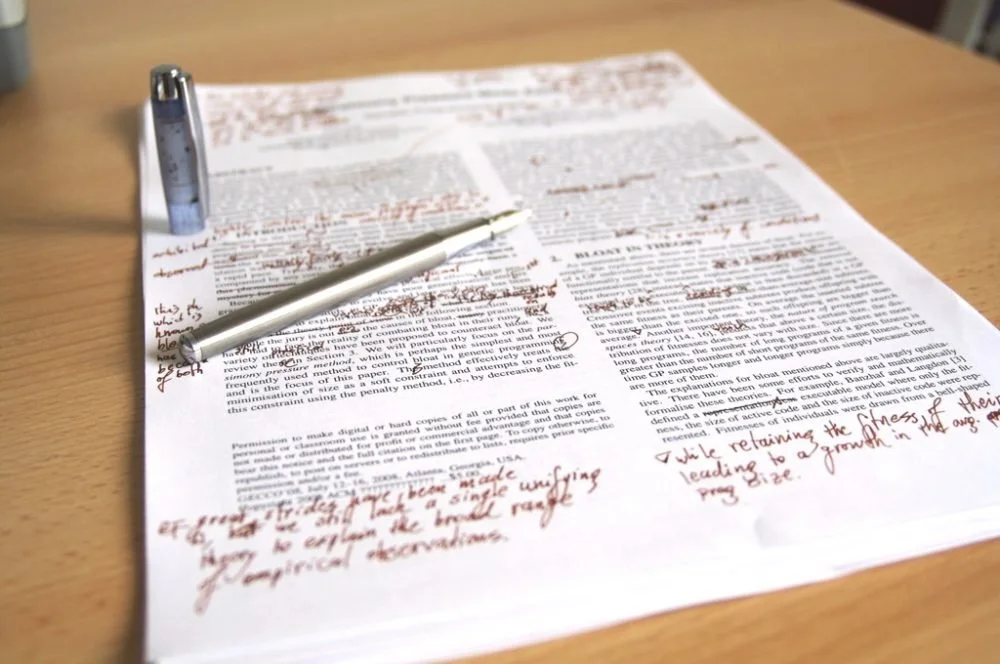
It’s also a terrifying thing getting your hard work back with someone’s comments and suggestions all over it. You might think that means your work wasn’t good enough to succeed. I promise it’s not that. It’s just a fresh pair of eyes giving an objective opinion.
For me, the decision ended up being well worth it. Because my editor pointed out mistakes I didn’t even know I was making.
Flaw no. 1: Over-explanation of World Building
When you’re writing in a genre that requires extensive world building, you are so keen to share this new world you’ve created with your readers. You eagerly attempt to use the story to share every crumb of it: explaining in detail the political structures, religious beliefs, natural environments and cultures. Me writing science fiction, I have a whole host of different planets with different climates and different people living there and sometimes I get desperate to get it all in, worried my readers won’t understand the world without it.
But there is such a thing as over explaining. There is such a thing as allowing the details to overtake the story. It’s something I was pulled up on. I was gently encouraged to trust the reader with certain details and lace in what was relevant and important to the plot. I refocused on the worlds that were important to the story, and the politics, cultures and religions that play a central role for the characters I am trying to make people know and love.
World building is great fun, but isn’t this story I’m trying to tell the reason I built the world in the first place?
Flaw no. 2: Too Many Names, Not Enough Pronouns
“Katherine walked into the shopping centre and looked around. Katherine noticed that the strawberries weren’t in their usual place. Katherine sighed and shook her head in frustration.”
What’s wrong with this group of sentences? It’s the fact that I repeatedly used the character name. Even though you can tell by the first sentence I am talking about Katherine, I continued to clarify for no reason I was talking about Katherine.
My editor would say “it’s okay to throw in a she or a her into this sentence. We know you’re talking about Katherine.”
In my novel it usually happened when there were two characters in the mix. Sure, more than that and I might need to do some clarity on who is speaking. But with only two characters dialoguing or reacting to each other, at some point I can dispense with their names. There are other ways to convey who I am talking about. I can also put some trust in the reader here: if they’re following the conversation it shouldn’t need a name drop in every single sentence.
Flaw no. 3: Wordiness
Why say it in 5 words when 50 will do? I’ll tell you why. Because your readers are going to sit there and yell at your pages, screaming “get to the point!”
I wanted my work to sound well thought out and sophisticated. But I can use language in a way that is still concise and achieve the same end goal.
Here my editor was watching for long descriptions where I took a long time to say what I mean, or repetitive phrases or sentences that made exactly the same point.
When writing a debut, word count is such an important consideration because a 200,000 word tome written by an unknown author is just not going to get picked up. Words need to be cut and stories need to move at a good pace that keep readers engaged. Sometimes that means cutting out that sentence that serves no purpose, even if I did like the way I wrote that when I was drafting the book.
Flaw no. 4: The Show Don’t Tell Debate
I’m going to name it because this advice is so common. And I’m going to caveat it arguing there is a place for telling. Where my editor picked it up for me was in some highly charged and climactic moments in the novel. Her feedback was in those places where there was all this detail about what was happening but not enough to pull her in yet. What are the feelings? The expressions? The colours? The sounds? The smells? Those are the things that invoke emotion and empathy in readers in a scene like that.
When it was done well, she pointed it out. She admitted when I made her laugh, cry or feel euphoric. But it meant that when I didn’t hit those marks, I left her wanting. I needed to know that. Because as a reader I have been there too: in a scene with so much happening that made me feel nothing because there wasn’t enough there to make me feel something.
Show doesn’t have to be a replacement for telling, I don’t think. There are times where you are giving important context or moving the plot along. But in the big moments, there’s nothing wrong with using some sensory language and descriptors that are going to invoke some very big feelings.
And Now?
Working on a new manuscript now, I am far more aware. Those things I got pulled up on when editing my first novel has made me think about them moving forward. So much so that I am picking it up myself in my personal re-reads and re-works.
Which will save the next editor some work, but also give them space to find new things to pick up. Because there is always something I can learn from.