Artificial Intelligence or Artistic Integrity: weighing in on the AI debate
Using AI to create art. It’s a debate circulating every day. Artists are in court filing lawsuits. Even the Australian Government is announcing bills to protect the arts from the use of Artificial Intelligence tools.
Specifically, in the space of the arts, we are mostly debating the ethics and legalities of using what is called “generative AI”. We are talking about those tools that create new content based on whatever prompt is given. Think tools like Chat GPT, CoPilot or Grok. Tools that can write you a word, a phrase or even a whole novel; or create you an image or series of images from nothing.
Unfortunately, since the advent of these tools, it seems to be becoming common place. Every day on social media, authors are sharing stories of having their works plugged into generative AI tools like Chat GPT without their permission; having a manuscript they trusted to an editor completely rewritten or changed using AI; trusting a visual artist to design some character art for them only to receive something back generated with AI.
Agents and publishers are sharing the hours they are spending being forced to sort out large quantities of AI generated work to get to the authors who have worked hard on their manuscripts without using these tools.
What a time to be alive where generative AI tools are being misappropriated in such a fashion?
So why rage against this machine?
Prophets of Rage: Living on the 110 - album art
Advocates against AI advocate against it on the basis of theft. Authors who have never used AI in their life are being accused of using it.
So, why is it considered theft? And why might authors find themselves in the firing line even if they never touched AI?
It’s because generative AI is trained using existing content. That’s why you can ask it to “write me a book in the style of Stephanie Meyer” for example. Because the tool has been fed her books, studied her writing style and pulled out the key elements of syntax, grammar and structure consistent in her novels. It then uses that to spit out a random idea that uses those key structural elements. Though it wouldn’t surprise me if there are a lot of thematic similarities as well.
Now, a lot of writing formulas and rules are the things we learned through study:
Say you use an em dash because you were taught this was absolutely an appropriate way to indicate a new thought (or you read it thousands of times in your collection of Jane Austen novels).
You’ve been taught since you could write sentences that the Oxford comma is grammatically correct.
Say you write in UK English instead of American English, or vice versa, by virtue of where you live.
Or you are person who just loves to throw in a good oxymoron wherever you possibly can because you really enjoyed learning what those were in school.
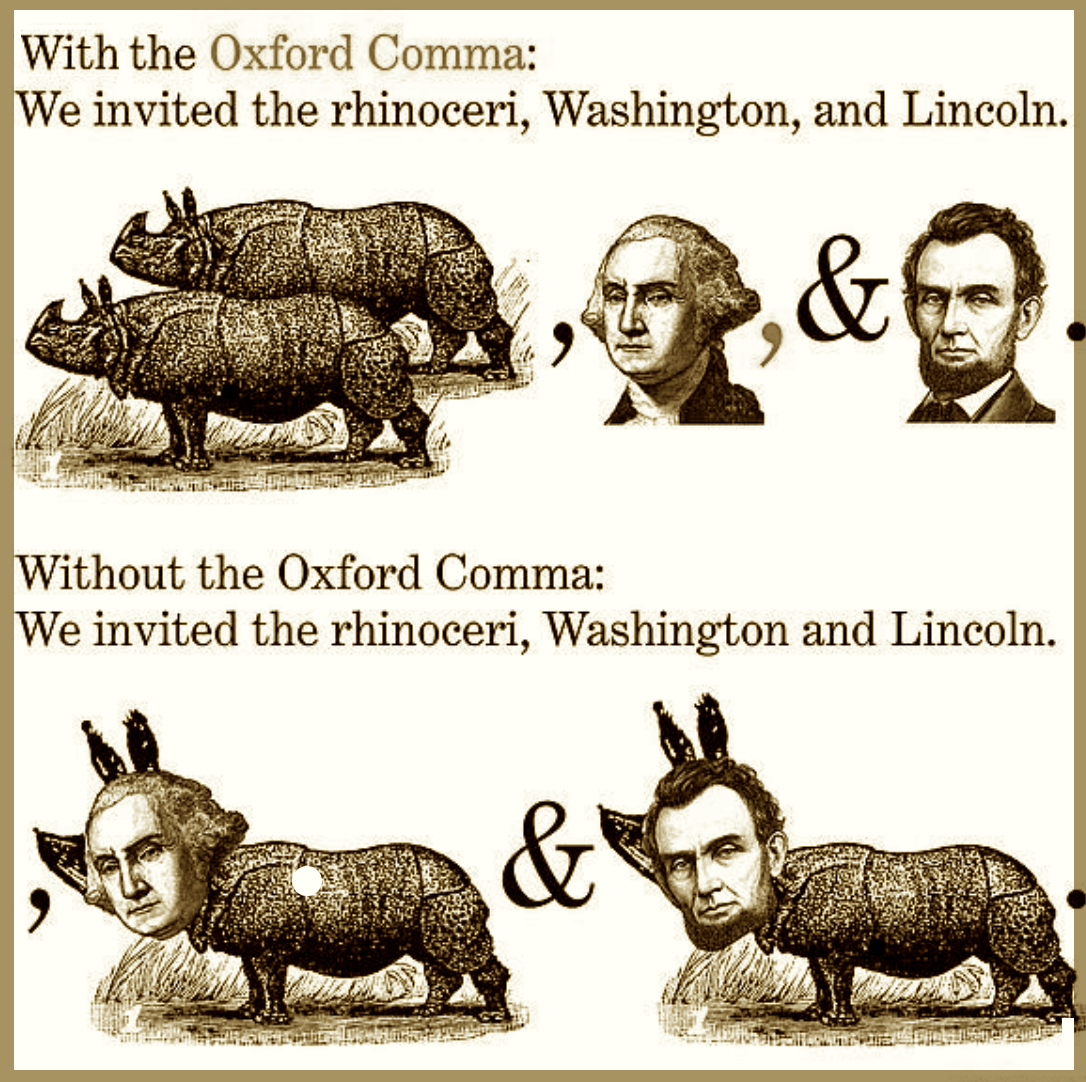
The Oxford Comma
These are techniques you probably learned early one and have been writing with your whole life. It’d be pretty jarring as an author to be told these techniques ingrained into your style are evidence you used AI.
For the record: I use the em dash because my professional editor told me to. So if I get accused of AI use, I am simply going to blame them
(Not really, I’m actually going to defend them with my whole heart because I do not believe they used AI either, since it was in my contract).
I do understand where the suspicion comes from, because there are authors who have, in fact, used it and submitted that work for publication. The unfortunate fallout is this is now taking away from authors who have worked hard.
Authors are pushing back on their works being used to train AI tools all over the world. Class action lawsuits are being filed all over the place. Recently, in my home of Australia, the Prime Minister announced that Australian writers keep total control and ownership of their material and that using their work without their express authorisation is considered theft.
But there are those who are pro-AI. What is the argument there?
The one I mostly hear and see is accessibility.
Pro AI advocates claim that AI has improved access to the industry for those who may be able to use these tools to assist them to achieve their dream of becoming a writer.
Okay, fair enough. But I think there is a line. That line is between generative AI and what is called Assistive AI.
The key difference is it’s capacity to create entirely new content from scratch. Assistive AI doesn’t do that. Generative AI does. Assistive AI is used to do just that: assist.
You might use assistive AI tools like Grammarly to correct your spelling and grammar, whilst still using your words. Assistive AI might be used to edit or modify an image to remove unwanted things or to improve the quality, but the image is one you drew or took yourself. You may use speech to text tools or interpreter tools.
I don’t believe these kinds of AI tools are the ones that anti AI advocates are vehemently against. Because, at the end of the day, it’s still your own work. These tools didn’t write the book, draw the art or create the music for you. They simply helped you to make it better.
Ultimately AI is incapable of original thought.
And that’s why it can’t ever fully replace what humans do. We are capable of so much. We have imagination and creativity. A robot or a program can never conjure up something drawn purely from soul or inspiration.
Trust me, we don’t want them to take over. I mean, we’ve all seen i-Robot haven’t we?
i-Robot (2004)
It comes down to our own AI: by that I mean Artistic Integrity
The stance I take as an author is that I am very much against the use of generative AI at all under any circumstances. Because I do agree with the idea that using generative AI is considered to be theft.
I would hate the idea of stealing someone else’s work to create my own.
Assistive AI, in many cases alright, as long as it is used ethically to aid your own work and ideas. Again, assistive AI doesn’t have the ability to create things from scratch using someone else’s content.
It comes down to integrity. It comes down to presenting work to the world that is authentically your own. It comes down to being honest about what you did and didn’t create.
If you want to be a writer, understand that it’s a job. That job requires work. And that work needs to be entirely your own. Generative AI is not going to help you do that. It’s going to give you the work of someone else.
Best way to avoid that? Don’t use Gen AI. Don’t even think about it.